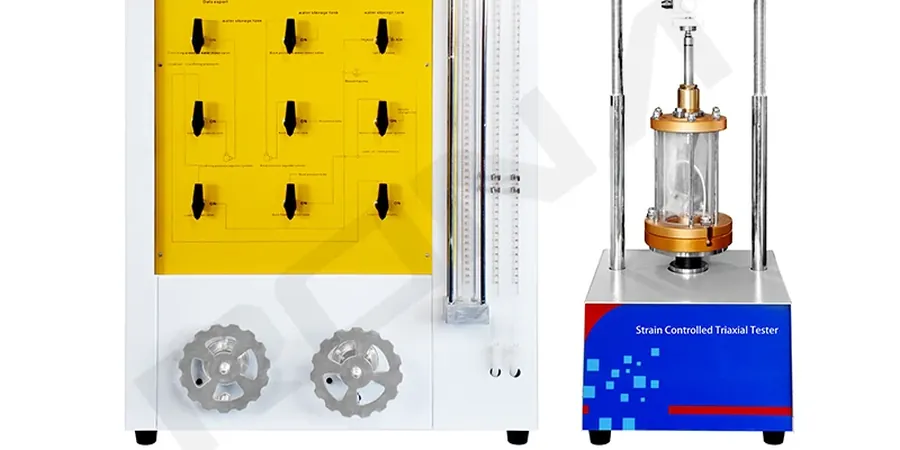
In Calgary, the glacial till and clay shale formations beneath the city often show significant variability in drainage conditions, making undrained and consolidated triaxial tests essential for safe foundation design. Before specifying a retaining wall or slope geometry, the project team should correlate the Mohr-Coulomb envelope from a triaxial test with the site-specific stratigraphy. A standard consolidated undrained (CU) test on undisturbed samples from the Paskapoo Formation typically yields effective friction angles between 28 and 34 degrees, but local experience shows that the presence of sand lenses can drop this value. We integrate this data with a slope stability analysis when designing cut slopes for the LRT or residential developments in the northwest quadrant.
A CU triaxial on Calgary till typically shows effective phi' of 30 to 34 degrees, but sand lenses can reduce this by 5 degrees.
Methodology and scope
A typical multi-story project near the Bow River requires triaxial testing on at least three specimens per stratum to capture anisotropic behavior. The laboratory procedure follows ASTM D4767 for anisotropic consolidation when simulating pre-construction loading sequences. Key outputs include cohesion intercept (c'), effective friction angle (phi'), and pore pressure parameter A at failure. For sensitive clay layers below the water table, we recommend the following:
CU triaxial with pore pressure measurement (ASTM D4767)
Consolidated drained (CD) for long-term stability of MSE walls
The testing protocol also includes saturation verification through B-value checks, which is critical in the low-plasticity tills of Calgary.
Technical reference image — Calgary
Local considerations
The shallow groundwater table in Fish Creek Park and the Elbow River valley creates a risk of excess pore pressure buildup during construction. If the triaxial test does not include a post-peak softening stage, the design may overestimate residual strength in the clay shale units of the Bearpaw Formation. This oversight can lead to progressive failure in slopes or excessive settlement under mat foundations. A well-designed triaxial program accounts for the stress path that the soil will actually experience, not just a generic Mohr envelope. The laboratory must also verify that the sample disturbance from the Shelby tube does not mask the true peak strength.
Rapid test on undisturbed samples for immediate bearing capacity estimates. Typical for shallow foundations in unsaturated glacial till. Results give total stress parameters (cu, phi_u).
02
Consolidated Undrained (CU) Triaxial with Pore Pressure
Primary method for effective stress analysis. Used for slope stability and retaining wall design in Calgary's clay shale. Includes B-value check and strain-controlled shearing.
03
Consolidated Drained (CD) Triaxial
Slow drained test for long-term stability of earth structures and MSE walls. Essential for projects where pore pressure dissipation governs design life.
Applicable standards
CSA + CSA + CSA + CSA + ASTM D2850 (also CFEM Ch 2) (also CFEM Ch 2) (also CFEM Ch 2) (also CFEM Ch 2) (also CFEM Ch 2): Standard Test Method for UU Triaxial Compression Test, ASTM D4767 (CFEM Ch 4): Consolidated Undrained Triaxial Compression Test with Pore Pressure Measurement, NBCC 2020: National Building Code of Canada – Section 4.2 (Geotechnical Design)
Frequently asked questions
How many triaxial tests are typically required for a building foundation in Calgary?
For a residential project on uniform till, three CU triaxial tests per soil layer are standard. For commercial towers over 10 stories, the geotechnical engineer usually requests six to nine tests to capture variability across the site, especially near the Bow River alluvium.
What is the difference between UU and CU triaxial tests?
The UU test measures undrained shear strength without allowing consolidation, giving total stress parameters for immediate conditions. The CU test consolidates the sample first and measures pore pressure during shearing, yielding effective stress parameters (c', phi') needed for long-term stability analysis in Calgary's clay shale.
How much does a triaxial test cost in Calgary?
The typical cost for a CU triaxial test with pore pressure measurement ranges from CA$2,910 to CA$4,110 per test, depending on the number of consolidation stages and whether anisotropic consolidation is required. Volume discounts apply for projects requiring more than 10 tests.
Can triaxial test results be used for liquefaction assessment?
Triaxial tests can provide cyclic strength parameters for liquefaction analysis, but the standard practice in Calgary uses SPT-based correlations (Youd-Idriss 2001) for preliminary screening. For critical infrastructure near the Bow River, a cyclic triaxial test following ASTM D5311 is recommended.