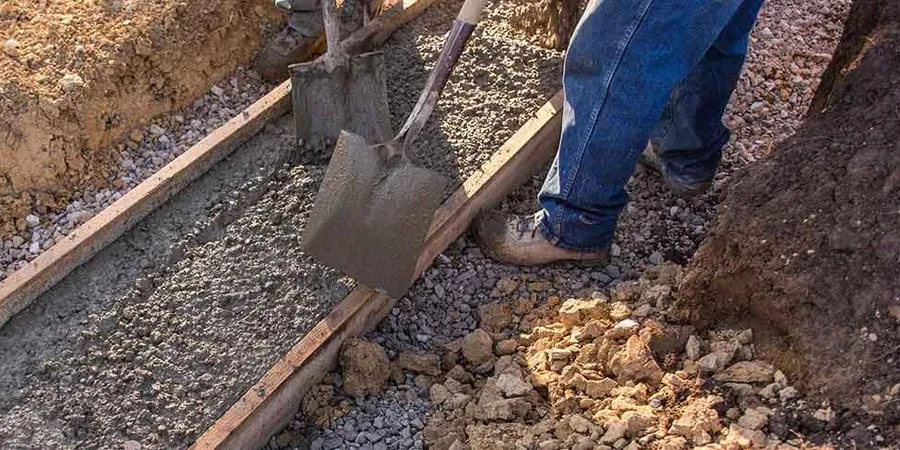
Calgary sits at over 1,045 meters above sea level, with a semi-arid climate that brings freeze-thaw cycles from October through April. The city’s glacial till and clay-rich subgrades demand a precise road subgrade design to prevent differential heave and premature pavement failure. Our team evaluates the physical and mechanical properties of the soil — Atterberg limits, Proctor compaction, and soaked CBR — to define the design modulus and required thickness of the pavement structure. Before placing any fill, we recommend a geotechnical drainage assessment to manage the high water table common in low-lying areas of Calgary, such as along the Bow River floodplain.
Glacial till in Calgary can vary laterally in 20 meters — a single CBR value is never enough for a reliable road subgrade design.
Methodology and scope
A common mistake contractors make in Calgary is assuming the native till behaves uniformly across the site. The truth is that glacial deposits here vary laterally — you can have stiff clay in one borehole and silt with sand lenses just 20 meters away. That variability directly impacts road subgrade design because the modulus of subgrade reaction (k-value) and California Bearing Ratio (CBR) change with each soil type. We run a full suite of index and strength tests — grain size, Atterberg limits, and modified Proctor — to capture those differences. For projects requiring higher reliability, we combine those results with a CBR pavement analysis and field density verification using the sand cone method. Our reports always include a zone-by-zone subgrade classification so the design engineer can assign appropriate layer coefficients and avoid overdesign or unexpected settlement.
Technical reference image — Calgary
Local considerations
Under NBCC 2020 and the Canadian Highway Bridge Design Code (CSA S6:19), the road subgrade design must account for frost action and bearing capacity simultaneously. Calgary’s freeze-thaw cycles can reduce subgrade strength by up to 50% in spring, leading to pavement deformation and cracking. If the design misses the soaked CBR or ignores the clay’s expansion potential, the road surface deteriorates within two winters. We always test at natural moisture content and after soaking to simulate the worst-case spring condition, and we document the results in a format ready for the pavement designer to input into AASHTOWare or similar mechanistic-empirical models.
Determines the California Bearing Ratio at field density and moisture conditions, with optional 4-day soak to simulate spring thaw.
02
Modified Proctor Compaction
Establishes the maximum dry density and optimum moisture content for subgrade and fill materials using ASTM D1557 (also CFEM Ch 2) (also CFEM Ch 2) (also CFEM Ch 2) (also CFEM Ch 2) (also CFEM Ch 2).
03
Atterberg Limits & Grain Size
Classifies the soil and identifies swelling potential, frost susceptibility, and drainage characteristics.
04
Field Density Control (Sand Cone / Nuclear Gauge)
Verifies compaction compliance on site, with immediate reporting to avoid rework during earthworks.
Applicable standards
ASTM D1883 – CBR of laboratory-compacted soils, ASTM D698 (also CFEM Ch 2) (also CFEM Ch 2) (also CFEM Ch 2) (also CFEM Ch 2) (also CFEM Ch 2) / D1557 – Standard and modified Proctor, CSA S6:19 – Canadian Highway Bridge Design Code, NBCC 2020 – National Building Code of Canada (frost depth requirements), CSA A23.2-2A – Atterberg limits
Frequently asked questions
What is the typical CBR range for Calgary's glacial till subgrade?
Calgary's glacial till usually yields soaked CBR values between 3% and 12%. The lower end corresponds to high-plasticity clay zones, while sandy till can reach 15%.
How does frost depth affect road subgrade design in Calgary?
NBCC 2020 specifies a frost depth of 1.8 to 2.4 meters for Calgary. The subgrade must be non-frost-susceptible within that zone, or a granular sub-base must be placed to prevent ice lens formation.
Do you provide k-value (modulus of subgrade reaction) from CBR?
Yes. We convert soaked CBR to k-value using the AASHTO correlation (k = CBR × 1.5 for fine-grained soils). The result is reported in MN/m³ for direct input into pavement design software.
How much does a complete road subgrade design test package cost in Calgary?
A typical package including CBR, Proctor, Atterberg limits, and grain size ranges from CA$1.290 to CA$4.680 depending on the number of samples and whether field density verification is included.