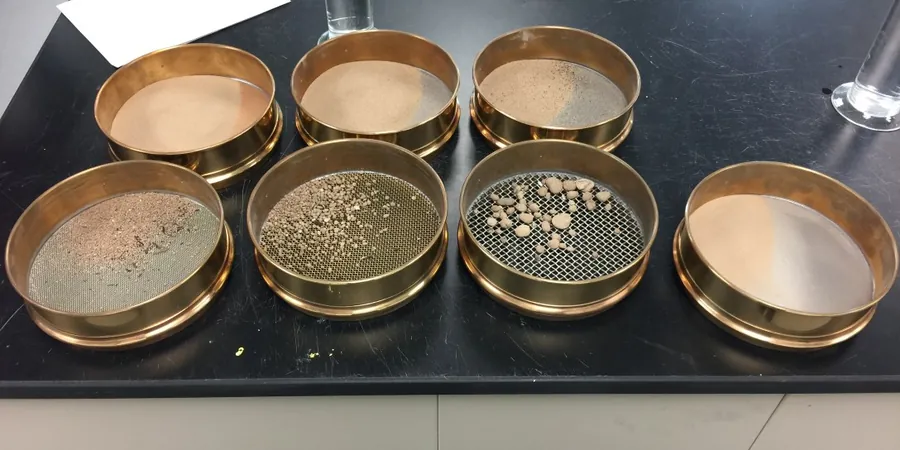
A 6-story apartment building going up in Calgary's Beltline district required a detailed grain size analysis before foundation design could proceed. The site's glaciolacustrine clay and silt layers, typical of the city's post-glacial geology, demanded both sieve and hydrometer testing to fully characterize the particle size distribution. Without that data, the structural engineer could not reliably estimate settlement or select the correct compaction method for the backfill around the new basement walls. The grain size analysis performed on split-spoon samples from three boreholes revealed that over 40 percent of the material passed the No. 200 sieve, which immediately flagged the need for drainage provisions and a complementary permeability test to assess water flow through the fine-grained matrix.
In Calgary's glacial till, the hydrometer phase of a grain size analysis is the only reliable way to detect clay fractions that drive frost heave and settlement risk.
Methodology and scope
Calgary's subsurface is dominated by glacial till, lacustrine clays, and outwash sands deposited during the Wisconsin glaciation. The till typically contains a wide range of particle sizes from cobbles to clay, so a combined sieve and hydrometer approach is the only way to capture the full gradation curve. In many residential subdivisions west of the Bow River, the near-surface soils are silty sands with fines content between 15 and 30 percent — a material that behaves differently under compaction depending on whether the fines are plastic or non-plastic. That distinction requires not only grain size analysis but also the Atterberg limits to classify the fines correctly. The hydrometer test measures the clay fraction below 0.075 mm, which governs frost susceptibility and swelling potential in Calgary's freeze-thaw cycles. For pavement subgrades along Deerfoot Trail, the grain size curve directly informs the selection of base course aggregates and the need for separation geotextiles. When the fines content exceeds 12 percent, a CBR test on the recompacted sample provides the bearing ratio needed for flexible pavement design per the city's roadway standards.
Technical reference image — Calgary
Local considerations
Calgary grew rapidly through the 1970s and 80s, with many subdivisions built directly on glacial till without thorough particle size characterization. The result: differential settlement in houses on the city's west side, where lenses of silty clay within the till compact unevenly under the building load. In commercial developments near the Bow River floodplain, the combination of high groundwater and fine-grained soils has caused frost heave damage to shallow foundations. A proper grain size analysis identifies those problematic silt and clay lenses before the foundation is poured, allowing the geotechnical team to recommend deeper footings, soil replacement, or a capillary break layer. For road embankments along Stoney Trail, ignoring the fines content has led to slope instability after spring thaw. The City of Calgary now requires gradation testing for all new infrastructure projects, and the NBCC 2020 references ASTM D6913 for foundation investigations in frost-susceptible soils.
Oven-dried at 110 ± 5°C; dry sieve unless wash sieve is specified
Associated technical services
01
Dry Sieve Analysis (Coarse Soils)
For gravels, sands, and crushed aggregates. Uses a mechanical shaker with sieves from 75 mm down to No. 200. Reports percent retained on each sieve, cumulative passing, and coefficients of uniformity (Cu) and curvature (Cc). Suitable for road base, concrete aggregate, and granular fill.
02
Wash Sieve + Hydrometer (Fine Soils)
Combines a wet wash through the No. 200 sieve to remove fines, followed by dry sieving of the retained fraction and hydrometer sedimentation of the passing fraction. Required for silts, clays, and any soil with more than 10 percent passing No. 200. Delivers the full gradation curve down to 0.001 mm.
03
Sieve Analysis with Atterberg Correlation
Integrates the gradation data with liquid limit and plastic limit results to classify the soil per the Unified Soil Classification System (USCS). Essential for determining frost susceptibility, shrink-swell potential, and compaction characteristics. The combined report includes the plasticity chart and group symbol.
Applicable standards
ASTM D6913-17: Standard Test Methods for Particle-Size Distribution of Soils Using Sieve Analysis, CSA + CSA + CSA + CSA + ASTM D422 (also CFEM Ch 2) (also CFEM Ch 2) (also CFEM Ch 2) (also CFEM Ch 2) (also CFEM Ch 2) (2014): Standard Test Method for Particle-Size Analysis of Soils (Hydrometer), AASHTO T-88-19: Particle Size Analysis of Soils (Sieve and Hydrometer), CSA A23.1: Concrete Materials and Methods of Concrete Construction (aggregate gradation reference)
Frequently asked questions
Why does grain size analysis matter for Calgary residential construction?
Calgary's glacial till contains a wide particle size range. Without a gradation curve, builders cannot predict how the soil will compact, drain, or behave under foundation loads. The hydrometer test specifically detects clay fractions that cause frost heave and differential settlement — two common issues in city neighborhoods built on till.
How much does grain size analysis cost in Calgary?
A standard sieve-only analysis typically ranges from CA$130 to CA$200, while a combined sieve and hydrometer test runs between CA$180 and CA$260. Prices vary with sample quantity, the number of sieves used, and whether Atterberg limits are included. Contact our lab for a project-specific quote.
What is the difference between dry sieve and wash sieve analysis?
Dry sieve analysis works well for clean sands and gravels. Wash sieve analysis uses water to separate fines from the coarser particles before sieving, which prevents clay and silt from clogging the sieve openings. For Calgary soils with more than 8 to 10 percent passing No. 200, wash sieve with a hydrometer is the required method to avoid misclassifying the soil as coarser than it actually is.