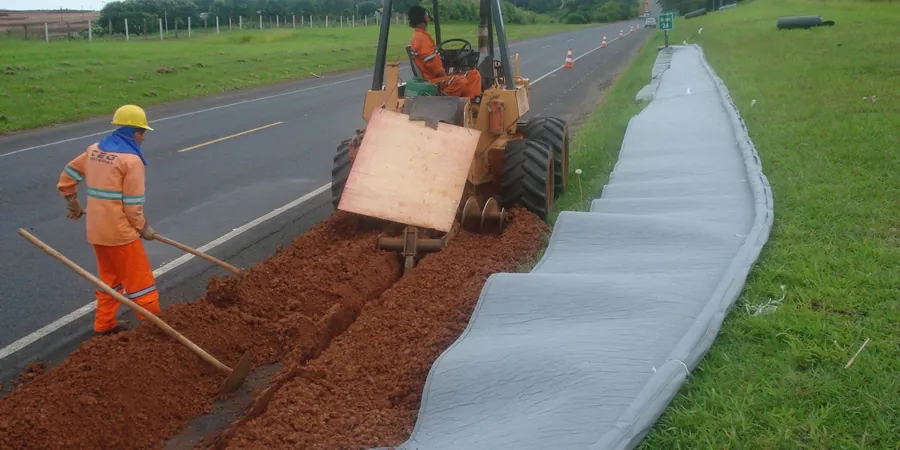
The contrast between Calgary's downtown core and the sprawling communities of the deep south like Auburn Bay tells you a lot about our soils. Downtown sits on dense glacial till, which drains reasonably well but presents its own challenges for excavation. Out in the new subdivisions, you hit glaciolacustrine clays and silts that hold water like a sponge. A road built on that without proper geotechnical road drainage can become a skating rink every spring thaw. We have designed drainage systems for collectors in Skyview Ranch that had to handle perched water tables appearing three feet below grade, something you rarely see in the inner city. The key is knowing where your water table sits before you pour any pavement. That is why we always combine site investigation with a CBR test to assess subgrade strength under saturated conditions, and a permeability test in the field to measure actual infiltration rates rather than guessing from soil type alone.
A road built without proper geotechnical drainage on Calgary's glaciolacustrine clays can become a skating rink every spring thaw.
Methodology and scope
We bring a track-mounted drill rig and a vacuum excavator to Calgary sites, and we set up monitoring wells with automated pressure transducers. The rig can reach 30 meters through till, but what matters most is the testing program around the proposed drainage. We install piezometers at multiple depths to capture the vertical hydraulic gradient. That data feeds directly into our drainage design, whether we are specifying French drains, trench drains, or edge drains. For a recent job on Stoney Trail, we ran falling-head tests in standpipes and correlated the results with a particle size distribution from the lab to confirm the soil's filtration compatibility with the proposed geotextile. We also verify compaction of the drainage trench backfill using a density test with the sand cone every 50 meters along the alignment. That level of control prevents settlement under traffic loads years down the road.
Technical reference image — Calgary
Local considerations
The most common mistake we see contractors make in Calgary is assuming that because the surface is dry, the soil below is dry. They cut a road subgrade in July, place granular base, and pave. By the following March, frost heave has pushed the pavement up four inches because a shallow perched water table was never detected. Geotechnical road drainage should never be an afterthought. We have investigated roads in Chaparral where the subgrade turned to slurry after a wet fall, and the only fix was removing the entire pavement section and installing a drainage blanket. That is a six-figure repair that could have been avoided with a proper subsurface investigation and a simple drainage layer during construction.
We install piezometers, conduct falling-head and constant-head tests, and analyze soil stratigraphy to determine drainage requirements. Our designs include trench drains, edge drains, and drainage blankets with proper filter layers, including geotextile specification and stone gradation.
02
Drainage Construction Monitoring and Verification
During construction, we supervise excavation of drainage trenches, verify compaction of backfill materials, and perform in-situ permeability tests on the installed drainage system. We also review the connection of drainage outlets to stormwater infrastructure.
How is geotechnical road drainage different from standard stormwater drainage?
Standard stormwater drainage handles surface runoff. Geotechnical road drainage targets subsurface water that weakens the subgrade, causes frost heave, and leads to pavement failure. We focus on intercepting groundwater and perched water tables before they reach the road structure.
What is the typical cost for a geotechnical road drainage study in Calgary?
For a typical residential collector road project, the cost ranges between CA$1,230 and CA$3,790 depending on the number of boreholes, monitoring wells, and laboratory tests required. Larger arterial roads with multiple drainage zones will be at the higher end.
How deep do drainage trenches need to be in Calgary's soils?
Depth depends on the seasonal frost depth and the position of the water table. In Calgary, frost depth reaches about 1.8 meters. We typically design trench drains to a depth of 1.5 to 2.5 meters, ensuring they extend below the frost zone and into a permeable layer where water can be collected and conveyed away.
Can you retrofit drainage on an existing road that has pavement damage?
Yes, we design retrofit drainage systems. The approach usually involves installing trench drains along the shoulders, sometimes with horizontal drains drilled under the pavement. We also evaluate whether the existing subgrade can support the new drainage without full reconstruction. This is common in older Calgary subdivisions where original drainage was minimal.
What geotextile specifications do you recommend for drainage applications?
We specify non-woven geotextiles with an Apparent Opening Size (AOS) of 0.30 mm or smaller and a permittivity of at least 0.5 s⁻¹. The geotextile must meet the filtration criteria of the soil it contacts, which we verify through particle size analysis and gradient ratio tests. We follow the FHWA design guidelines for geotextile selection.