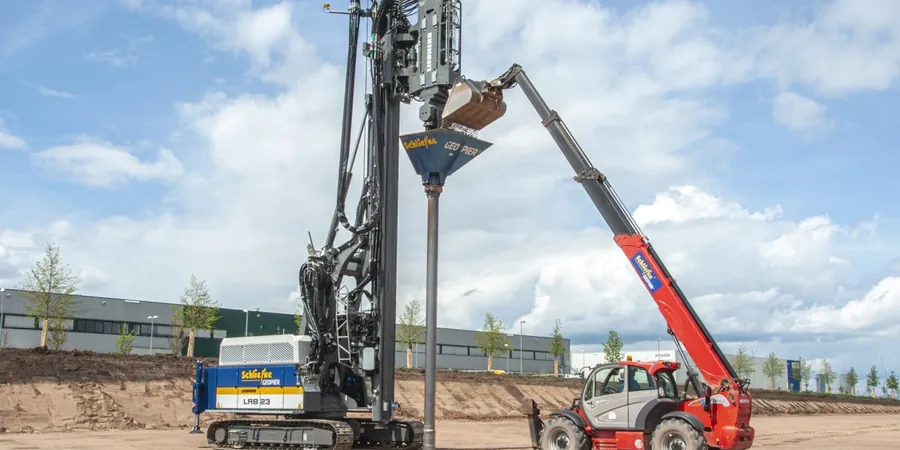
Calgary's freeze-thaw cycles and glacial till deposits demand precise geotechnical data. The Ménard pressuremeter test (PMT) measures soil stiffness and strength directly in the borehole. Unlike lab tests on disturbed samples, PMT captures the in-situ stress-strain response under controlled radial expansion. For projects on Calgary's Bow River terraces or the Paskapoo Formation, this test provides critical parameters for foundation design. We run the PMT per ASTM D4719, using a calibrated probe and real-time data acquisition. The result? Reliable deformation modulus (E_M) and limit pressure (p_L) values you can trust for tall buildings, bridges, and retaining walls in Calgary.
PMT delivers in-situ soil stiffness directly, avoiding sample disturbance that plagues lab triaxial tests on Calgary's dense glacial till.
Methodology and scope
We follow ASTM D4719-20 strictly for every Ménard pressuremeter test in Calgary. The probe is inserted into a pre-drilled borehole at target depth. Nitrogen gas expands a flexible membrane against the borehole wall. The pressure-volume curve gives us two key outputs: the Ménard modulus (E_M) and the limit pressure (p_L). These feed directly into bearing capacity and settlement calculations per NBCC 2020. For deep foundations in Calgary's hard till, we often combine PMT with ensayo CPT to cross-check soil behavior.
Deformation modulus (E_M) for immediate settlement analysis
Limit pressure (p_L) for bearing capacity of piles and footings
Creep pressure (p_f) to assess long-term deformation
Each test takes about 30 minutes per depth zone. We calibrate the probe before every project using a rigid cylinder.
Technical reference image — Calgary
Local considerations
A common issue we see in Calgary is over-reliance on SPT blow counts alone for till soils. The SPT N-value can be misleading in dense, cemented till layers. PMT reveals the true stiffness under load. Without it, you risk excessive settlement predictions — or worse, underestimating bearing capacity. In Calgary's floodplain zones near the Bow River, the PMT also detects soft compressible layers that SPT might miss. We always recommend at least one PMT per soil layer for major structures. It's a small investment that prevents costly foundation redesigns.
One borehole, three test depths. Ideal for residential or light commercial foundations in Calgary. Includes field data and a summary report with E_M and p_L values.
02
Advanced PMT (multiple boreholes)
Up to five boreholes with staggered test depths. Designed for mid-rise buildings, bridge abutments, and retaining walls. Full interpretation including creep pressure and modulus ratio analysis.
03
PMT with SPT correlation
Combined PMT and SPT program at same boreholes. We cross-correlate E_M with N-values to build a site-specific stiffness profile. Recommended for large subdivisions or infrastructure projects in Calgary.
Applicable standards
ASTM D4719-20: Standard Test Methods for Prebored Pressuremeter Testing in Soils, NBCC 2020: National Building Code of Canada — Part 4 (Foundations), CSA A23.3-19: Design of Concrete Structures (Annex for deep foundations), FHWA NHI-05-042: Manual on Subsurface Investigations (pressuremeter section)
Frequently asked questions
What does the Ménard pressuremeter test measure in Calgary soils?
The PMT measures the in-situ stress-strain behavior of soil by expanding a cylindrical probe against the borehole wall. It outputs the Ménard modulus (E_M) for settlement analysis and the limit pressure (p_L) for bearing capacity. In Calgary's glacial till, it captures the true stiffness of dense, overconsolidated layers that SPT cannot differentiate.
How much does a pressuremeter test cost in Calgary?
For a standard three-depth test in one borehole, expect a range of CA$1,250 to CA$1,920. This includes mobilization, probe calibration, field execution, and a basic report. Costs increase with additional boreholes, deeper depths, or combined SPT-PMT programs. Contact us for a detailed quote tailored to your project scope.
What is the difference between PMT and SPT for Calgary soils?
SPT measures resistance to dynamic penetration and gives N-values for empirical correlations. PMT measures static radial expansion and provides direct modulus values for settlement calculations. In Calgary's hard till, SPT may overestimate or underestimate soil stiffness due to cobbles or cementation. PMT avoids that by testing a larger soil volume in situ.
When should I use PMT instead of plate load test?
PMT is faster and tests deeper soil layers — up to 30 m depth. A plate load test only tests the top 1-2 m. For deep foundations (piles, caissons) in Calgary, PMT is the standard. Plate load tests are better for shallow footings on uniform soils. We often recommend PMT for mid-rise to high-rise buildings where deeper soil stiffness matters.