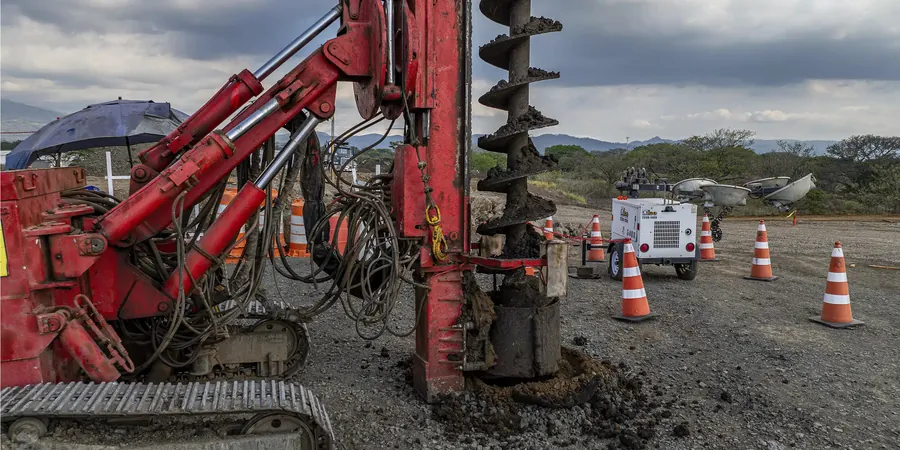
A mid-rise project in the Beltline district showed 35 mm of post-construction settlement on a soft clay till layer just 4 m below grade. We recommended stone columns as a ground improvement solution. The technique densifies the native soil and redirects load to deeper, stiffer strata. Before mobilizing the vibroflot, we always conduct a site-specific subsurface exploration with test pits to map the exact depth of the till. For Calgary's variable glaciofluvial fill, stone columns typically achieve a modulus of 15–25 MPa, cutting total settlement by 60–70% compared to untreated ground.
In Calgary's clay till, stone columns can reduce total settlement by 60–70% and increase bearing capacity from 150 kPa to over 350 kPa.
Methodology and scope
Calgary's subgrade alternates between high-plasticity clay till (CH) and loose sand layers deposited by glacial meltwater channels. Stone column design must account for the lateral confinement provided by the till. We follow the Priebe method (1995) calibrated against local field trials. Key parameters include area replacement ratio (15–35%), column diameter (0.6–1.2 m), and the drained friction angle of the backfill material (38–42°). For sites near the Bow River floodplain, where groundwater fluctuates seasonally, we couple the design with vertical drains to accelerate consolidation under preload. The combined system reduces both primary and secondary settlement in Calgary's soft lacustrine clays.
Technical reference image — Calgary
Local considerations
In Calgary, the main risk is encountering a buried channel of loose sand or organic silt beneath the till. We have seen projects where stone columns punch through into these soft layers, causing excess bulging and lost confinement. To avoid this, we always require a CPT or borehole every 300 m² on the grid. Another common issue is lateral displacement of adjacent utilities during vibroflotation. Pre-drilling a 0.3 m pilot hole reduces vibration damage. We also run a [MASW survey](/masw-vs30/) pre- and post-treatment to verify shear-wave velocity gain across the treated zone.
Review existing borehole data, assess till thickness and groundwater conditions, then calculate required area replacement ratio and column spacing using Priebe and Balaam & Booker methods. Deliverables include a design report with settlement estimates and a 3D grid layout.
02
Construction QA/QC and Verification
On-site supervision during vibroflotation, including continuous monitoring of amperage draw, backfill volume, and column top elevation. Post-treatment testing with CPT, plate load tests (ASTM D1194), and MASW to confirm modulus improvement and compaction density.
Applicable standards
NBCC 2020 (Clause 4.1.8 – foundation design for seismic), CSA A23.3-19 (concrete design for pile caps), CSA A23.2-9A / CSA A23.2-9A / CSA A23.2-9A / CSA A23.2-9A / CSA A23.2-9A / ASTM D1586 (SPT for soil classification), Priebe method (1995) – stone column bearing capacity
Frequently asked questions
What is the typical cost range for stone column design in Calgary?
The cost for stone column design and installation in Calgary typically ranges from CA$1.960 to CA$6.140 per column, depending on diameter, depth, and site access conditions. A full design report for a 10-column grid usually falls between CA$8.000 and CA$15.000.
How deep can stone columns treat soft ground in Calgary?
Standard vibroflot equipment reaches depths of 8 to 12 m in Calgary's clay till. For deeper soft layers, we may combine columns with preloading or vertical drains. The limiting factor is the vibroflot's ability to maintain consistent compaction at depth.
Do stone columns work in Calgary's high-plasticity clay till?
Yes. The till provides good lateral confinement, which is essential for stone column performance. We have designed columns with area replacement ratios as low as 18% and achieved bearing capacities exceeding 350 kPa. The key is to avoid over-reliance on the till's undrained shear strength alone.
What verification testing is required after stone column installation?
We recommend a combination of CPT soundings (one per 500 m²), plate load tests (one per 1,000 m²), and MASW profiles across the treatment grid. These methods confirm modulus improvement, column continuity, and the absence of soft pockets between columns.