A common mistake Calgary contractors make is assuming the city’s glacial till provides uniform bearing capacity everywhere. That assumption leads to differential settlement when a foundation hits a buried channel or a sand lens. Jet grouting design directly addresses this variability by creating cemented soil columns that improve strength and reduce permeability. The process involves injecting a high-velocity cement grout that mixes with and displaces the native soil. Before mobilizing equipment, Calgary teams should verify subsurface conditions with a drainage geotechnical study to identify water-bearing layers that could affect grout take. Without this step, the treatment may not reach design diameter. Proper jet grouting design in Calgary requires site-specific parameters, not cookie-cutter assumptions.
In Calgary’s glaciolacustrine clays, jet grouting columns must account for high plasticity and low permeability to avoid incomplete mixing at the periphery.
Methodology and scope
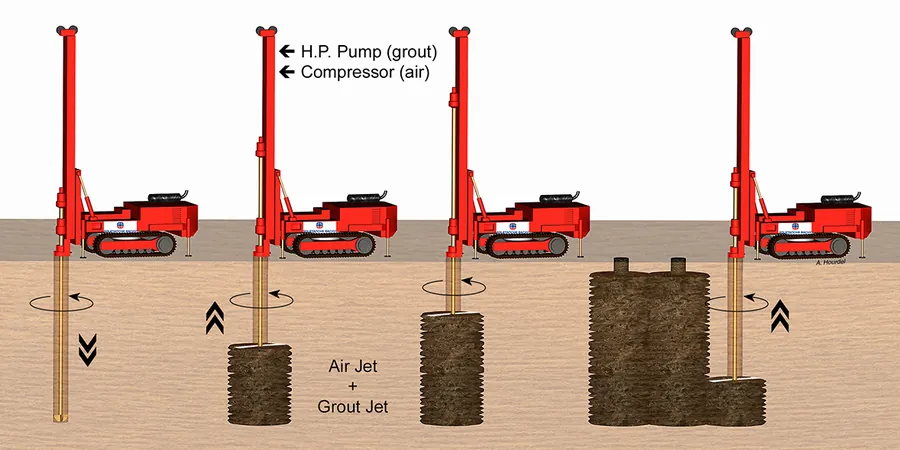
The equipment used for jet grouting in Calgary typically consists of a high-pressure pump, a rotating monitor rod, and a mixing plant on a tracked rig. The monitor delivers grout at pressures exceeding 400 bar through nozzles that cut and erode the soil while simultaneously injecting cement slurry. This creates columns that can reach diameters from 0.6 to 2.5 meters depending on soil type and energy. The design phase determines the optimal combination of pressure, rotation speed, and withdrawal rate. For projects near the Bow River corridor, geotechnical data from cone penetration testing helps refine these parameters because CPT provides continuous profiles of soil behavior. The team then runs trials on site to verify column diameter against design assumptions before full production begins.
Technical reference image — Calgary
Local considerations
Calgary experiences a semi-arid climate with freeze-thaw cycles that affect shallow groundwater levels. During spring melt, the water table can rise several meters, increasing pore pressures in the silt and clay layers. If jet grouting design ignores seasonal groundwater fluctuation, the injected grout may wash out or fail to achieve the required column diameter. The risk is especially high in areas with buried organic pockets or old river channels. A rigorous design must include piezometer monitoring during treatment and adjust the grout mix to account for dilution. Contractors who skip this step risk voids beneath foundations that only become visible after excavation.
We test local Calgary soils and water sources to formulate the right cement content, w/c ratio, and additives for the project’s strength and permeability targets. Trials include unconfined compression and permeability testing.
02
Column Diameter Verification
After jetting test columns, we excavate and measure the actual diameter and shape. This data feeds back into the design to calibrate pressure and withdrawal rates for production columns.
Applicable standards
CSA Z768 – Standard Practice for Design and Installation of Groundwater Monitoring Wells, CSA A23.3 – Design of Concrete Structures (grout mix design reference), NBCC 2020 – Part 4: Foundations and Geotechnical Resistance, FHWA Grouting Manual (FHWA-HRT-14-040) – Jet Grouting Guidelines
Frequently asked questions
What makes Calgary's glacial till challenging for jet grouting design?
The till contains discontinuous sand and gravel lenses that create preferential flow paths for grout. These lenses can cause column diameter to increase unpredictably or, conversely, reduce mixing efficiency in the surrounding clay matrix. A site-specific investigation using CPT or test pits is essential to map these lenses before design.
How much does a typical jet grouting design study cost in Calgary?
For a mid-sized project requiring 20–40 columns, the design and verification phase ranges from CA$2,450 to CA$8,760, depending on the number of trial columns, lab testing, and site conditions. Bulk pricing applies for larger volumes.
Is jet grouting suitable for Calgary's high plasticity clays?
Yes, but the design must account for the clay's low permeability and high water content. The grout must be formulated with a lower water-to-cement ratio and higher pressure to ensure adequate mixing. Pre-production trials are mandatory to confirm column integrity.