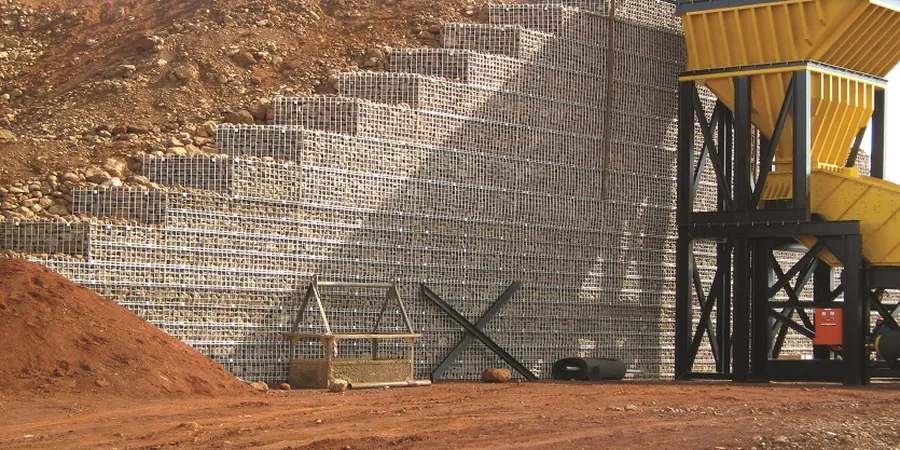
We worked on a 9-meter retaining structure along the Deerfoot Trail corridor where the native glacial till was competent but the backfill zone required careful compaction control. MSE wall design in Calgary demands attention to freeze-thaw cycles and the high sulfate content sometimes found in local soils. We combine limit equilibrium analysis with finite element checks to ensure the reinforced soil mass behaves as a coherent block under both static and seismic loads. For that project we also ran a geotechnical drainage study to manage water pressure behind the facing panels and a CBR evaluation to verify the subgrade support for the approach embankment. Every design starts with site-specific soil parameters from our laboratory tests, not textbook values.
Every MSE wall design in Calgary starts with site-specific soil parameters from our lab, not textbook values.
Methodology and scope
Calgary experiences over 100 freeze-thaw cycles per winter, which directly impacts the long-term durability of geosynthetic reinforcements. Our MSE wall design for Calgary always accounts for ice lens formation in the drainage layer and selects polyethylene geogrids with UV stabilization for exposed fascia. We follow CSA A23.3 for the concrete panel connection design and ASTM D6638 for the reinforcement pullout resistance. Here is what we check on every project:
Internal stability — reinforcement spacing, length, and creep rupture under sustained load
External stability — sliding, overturning, bearing capacity, and global slope failure using slope stability analysis
Drainage system — chimney drain with perforated pipe at the base to prevent hydrostatic pressure buildup
We also verify that the backfill meets the specified gradation and friction angle before any panel erection begins.
Technical reference image — Calgary
Local considerations
NBCC 2020 requires seismic design for any MSE wall in Calgary, which sits in a moderate seismic zone (Sa(0.2) ≈ 0.30 g). The most common failure we see locally is inadequate compaction of the reinforced zone — contractors sometimes use oversized equipment that damages the geogrid or leaves loose zones near the facing. Another issue is drainage clogging from fine particles migrating into the aggregate. We specify a high-permeability drainage blanket and a filter geotextile between the backfill and the native soil. All designs are reviewed by a professional engineer registered with APEGA before construction begins.
Polyester or polypropylene geogrids, ultimate tensile strength 40–200 kN/m
Backfill friction angle
Minimum 34° (ASTM D3080 direct shear test)
Design life
75 years per AASHTO LRFD, with creep reduction factor applied
Drainage aggregate
Clear crushed rock, 19–50 mm, wrapped in non-woven geotextile
Facing panel type
Precast concrete segmental, 1.5 m x 1.5 m, with shear keys
Associated technical services
01
Reinforced Soil Wall Design
Complete internal and external stability analysis using limit equilibrium and finite element software. We size reinforcement layers, select geogrid grade, design the drainage system, and produce shop drawings for precast panel facing. Every design is sealed by a professional engineer.
02
Construction Phase Support
On-site verification of backfill placement, compaction density (ASTM D6938), and geogrid orientation. We review contractor submittals, perform pullout tests on trial panels, and provide as-built documentation for the owner's record.
Applicable standards
NBCC 2020 — National Building Code of Canada, CSA A23.3-19 — Design of Concrete Structures, ASTM D6638 — Standard Test Method for Determining Connection Strength Between Geogrid and Concrete Facing, ASTM D5262 — Standard Test Method for Evaluating the Unconfined Tension Creep Behavior of Geosynthetics
Frequently asked questions
What is the typical cost range for MSE wall design in Calgary?
For a standard project with walls up to 8 m in height, the design fee including shop drawings and construction support ranges between CA$1,830 and CA$6,460. The final cost depends on wall length, site access, and the number of design iterations required. We provide a fixed-price quote after reviewing the geotechnical report.
How long does the MSE wall design process take?
A typical design takes 3 to 5 weeks from receipt of the geotechnical report. This includes internal stability checks, external stability analysis, drainage design, and shop drawing preparation. If the project requires seismic analysis per NBCC 2020, add one week for the response spectrum evaluation.
What geogrid type is recommended for Calgary's climate?
We specify polyester (PET) geogrids with a creep reduction factor of 0.40 to 0.50 for long-term applications. Polypropylene (PP) grids are acceptable for temporary walls but suffer higher creep under sustained load. All geogrids must be UV-stabilized if exposed for more than 30 days before covering.
Can MSE walls be built on soft clay or organic soil in Calgary?
Yes, but the foundation must be improved first. We typically recommend excavation and replacement of the soft layer with compacted granular fill, or installation of stone columns if the soft layer exceeds 3 m in depth. Global stability against deep-seated failure must be verified using the undrained shear strength of the underlying clay.