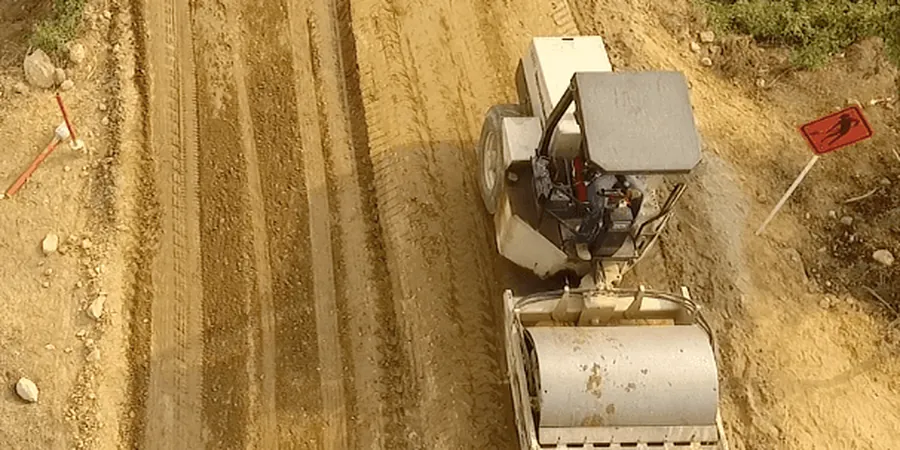
The contrast between the glacial till underlying much of Glenmore and the fat clays along Nose Creek valley defines Calgary's geotechnical challenge. In the southwest, dense till provides moderate bearing capacity but often contains cobbles that complicate mixing. In the northeast, the high-plasticity lacustrine clays swell and shrink dramatically with moisture changes. Lime and cement stabilization treats both extremes by reducing plasticity and increasing shear strength before pavement or foundation loads are applied. For embankments in the northwest, we often combine stabilization with a subrasante vial assessment to confirm the treated layer meets design CBR values. Each project in Calgary demands a mix design tailored to the local borrow source or in-situ material, not a generic recipe.
In Calgary's lacustrine clays, a 5% lime addition can reduce plasticity index from 42 to 18, transforming a problem soil into a workable subgrade.
Methodology and scope
The dominant soil type across Calgary is glacial till, underlain by the Paskapoo Formation sandstone and siltstone, but post-glacial lake deposits create pockets of highly plastic clay with plasticity indices exceeding 40%. These clays require careful chemical treatment. Our protocol for lime and cement stabilization in Calgary follows ASTM D6276 for lime and ASTM D1633 for cement-treated specimens. We first run Atterberg limits and Proctor compaction — often through a limites-atterberg evaluation — to establish untreated baseline values. The lab then blends incremental dosages, typically 3-8% lime or 4-10% cement by dry weight, and cures samples for 7 to 28 days. Unconfined compressive strength tests determine the optimum binder content. We also measure pH over time for lime-treated soils to confirm the pozzolanic reaction is sustained. Each batch is documented with the originating depth and GPS coordinates for traceability back to the specific Calgary lot number.
Technical reference image — Calgary
Local considerations
Calgary sits at 1,045 m above sea level on the edge of the Rocky Mountain foothills, where seasonal freeze-thaw cycles can exceed 100 cycles per winter. If a subgrade treated with lime or cement is not properly cured before the first frost, the pozzolanic reaction halts and the stabilized layer never reaches design strength. In the deep clay deposits found near the Bow River, unconfined compressive strength can drop by 40% after a single freeze-thaw cycle if the stabilization dosage was marginal. The risk is compounded by the city's chinook winds, which cause rapid surface drying and shrinkage cracking in cement-treated layers if the moisture content is not tightly controlled during placement and compaction.
We run a matrix of binder dosages, moisture contents, and curing times to determine the most economical and effective stabilization recipe for your specific Calgary borrow source or in-situ soil. The final report includes unconfined compressive strength, CBR, and Atterberg limits for each blend.
02
Field Verification Testing
After placement, we perform in-situ density tests (sand cone or nuclear gauge) and retrieve undisturbed cores for laboratory UCS testing. This confirms the treated layer meets the specified strength and compaction targets before the next lift or pavement course is placed.
03
Long-Term Durability Assessment
For projects with extended service life requirements, we conduct wet-dry and freeze-thaw durability tests on stabilized specimens. This data is critical for Calgary's climate, where the stabilized layer must withstand repeated cycles without disintegration.
Applicable standards
ASTM D6276-19 (Standard Test Method for Using pH to Estimate the Soil-Lime Proportion Requirement), ASTM D1633-17 (Standard Test Methods for Compressive Strength of Molded Soil-Cement Cylinders), NBCC 2020 Division B, Section 4.2 (Foundations and Subgrade Preparation), Alberta Transportation Design Bulletin for Subgrade Stabilization
Frequently asked questions
What is the difference between lime stabilization and cement stabilization for Calgary soils?
Lime stabilization works primarily with clay minerals through cation exchange and pozzolanic reactions, reducing plasticity and swell potential. Cement stabilization adds strength more rapidly through hydration and is better suited for granular soils or when early traffic loading is needed. For Calgary's high-plasticity clays, we often recommend lime first to modify the clay, followed by a small cement addition for strength gain.
How long does it take to complete a lime and cement stabilization mix design for a Calgary project?
A standard mix design with three binder dosages and two curing periods takes 4 to 6 weeks from sample receipt. If a preliminary dosage is needed for scheduling, we can issue an interim report with 7-day strength data in 3 weeks. Rush projects can be expedited to 2 weeks with a priority surcharge.
What is the typical cost range for lime and cement stabilization testing in Calgary?
The cost for a full mix design study including Atterberg limits, Proctor compaction, and UCS testing at three dosages ranges from CA$1,050 to CA$3,820 depending on the number of curing periods and the inclusion of durability cycles. Field verification testing is priced per test point and typically adds CA$150 to CA$400 per location.
Can lime and cement stabilization be applied to soils in Calgary's floodplain zones?
Yes, but with additional precautions. Soils in floodplain areas such as along the Bow or Elbow rivers often have higher organic content and variable moisture. We recommend a pre-treatment assessment that includes organic content determination and a pH test on the untreated soil. If organic content exceeds 2%, the stabilization effectiveness decreases and alternative binder systems may be required.