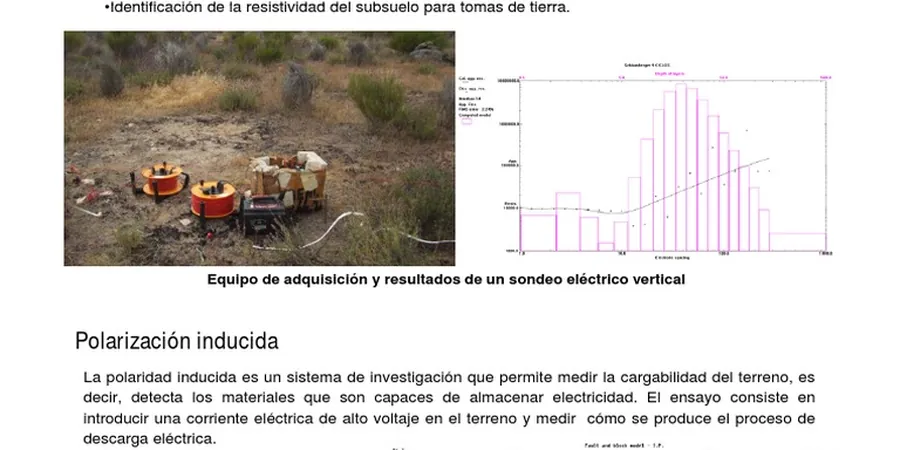
Many construction teams in Calgary assume the subsurface is uniform across the city. That assumption often leads to unexpected rock excavations or water seepage halfway through a project. We have seen it on sites near the Bow River where a thin clay crust hides a deep sand channel beneath. Without a proper subsurface image, foundation designs miss critical variations. An electrical resistivity / VES survey maps these contrasts before you break ground. It identifies clay lenses, sand layers, and bedrock interfaces without drilling a single borehole. This saves both time and mobilization costs. For projects where the soil profile changes abruptly, combining VES with a georadar survey gives a clearer picture of shallow obstructions and buried utilities.
A single VES line can replace five boreholes in glacial till when the goal is bedrock depth mapping.
Methodology and scope
A 15-story residential tower on Macleod Trail needed a foundation design that could handle variable glacial till thickness. The geotechnical team used vertical electrical sounding to profile the ground. The method works by injecting a known current into the soil through four electrodes and measuring the voltage drop. Resistivity values change with moisture content, clay content, and rock density. In Calgary, high resistivity often indicates dense gravel or bedrock, while low resistivity points to saturated clay or silt. Our field crew uses the Wenner array for horizontal resolution and the Schlumberger array for deeper penetration. Each sounding takes about 90 minutes with real-time data logging. We then invert the data using 1D and 2D modeling software. This gives the engineering team a resistivity cross-section that correlates with known geology from nearby ensayo SPT boreholes.
Technical reference image — Calgary
Local considerations
Compare the deep glacial till of northwest Calgary near Cochrane with the sandy fluvial deposits along Fish Creek. In the northwest, an electrical resistivity / VES profile shows high resistivity down to 30 meters, reflecting dense till with occasional boulders. Down south, the same survey shows low resistivity zones at 6 meters, indicating saturated sand and gravel. A foundation designed for the first site would fail in the second if groundwater seepage is not accounted for. This contrast is why standard borehole spacing alone cannot capture the lateral variability. The electrical resistivity / VES method fills that gap by providing continuous lateral coverage between boreholes.
Resistivity pseudo-section, interpreted cross-section, report with CAD overlay
Accuracy
±5% repeatability on homogeneous soils
Associated technical services
01
2D Resistivity Imaging (Multi-Electrode)
A continuous profile using 48 to 72 electrodes along a straight line. Ideal for mapping buried channels, bedrock pinnacles, and groundwater tables on large sites like subdivisions or highway alignments. Data is inverted to produce a color-coded resistivity section that engineers overlay on cross-sections.
02
Vertical Electrical Sounding (VES) – Point Soundings
A single expanding array at one location. Best for deep bedrock depth checks or verifying borehole results on small lots. Each sounding provides a 1D resistivity curve that resolves up to 5 layers. Used frequently for shallow foundation design in Calgary's residential zones.
Applicable standards
ASTM G57-20 (Standard Test Method for Field Measurement of Soil Resistivity), NBCC 2020 (National Building Code of Canada, Part 4 — Foundations), CSA A23.3-19 (Design of Concrete Structures — geotechnical parameters)
Frequently asked questions
How deep can electrical resistivity / VES reach in Calgary soils?
With the Wenner array and electrode spacing of 40 meters, we can investigate down to approximately 20 meters. For deeper targets like bedrock at 60 meters, we use Schlumberger arrays with spacings up to 100 meters. The maximum depth is about one-third of the total spread length.
What is the cost of a VES survey in Calgary?
A standard 10-point vertical electrical sounding costs between CA$970 and CA$1,340 depending on site accessibility and required depth. Multi-electrode 2D lines run higher due to mobilization and inversion processing. We provide a firm quote after reviewing the site plan.
Can VES detect groundwater in Calgary's glacial till?
Yes. Saturated till shows resistivity values below 50 ohm-meters, while dry till often exceeds 200 ohm-meters. The contrast is clear enough to identify perched water tables above clay layers. This is critical for dewatering planning in deep excavations.
How does electrical resistivity compare to test pits or boreholes?
VES provides continuous lateral coverage without disturbing the ground. Boreholes give exact point data but miss variations between holes. We recommend VES as a first pass to guide borehole placement, then correlate both datasets. This combination reduces total drilling costs by up to 30% on large sites.