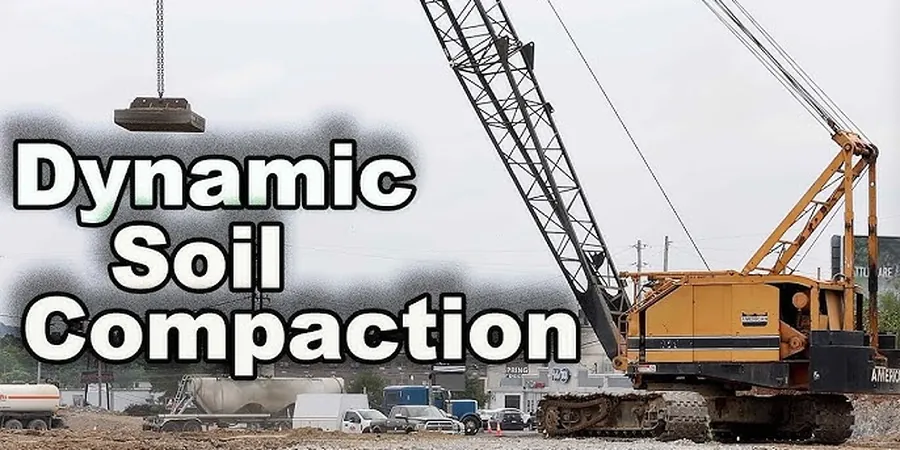
We were called to a site just off 32nd Avenue NE where the client had bought an old quarry turned industrial yard. The ground was a mix of loose sand, silty fill, and buried demolition debris — not a single consistent layer across the lot. Standard shallow foundations would have settled unevenly, so the owner asked for dynamic compaction design before any concrete was poured. Dropping a 20-ton weight from 25 meters is violent, yes, but it works when you map the grid correctly. We ran a pre-treatment georradar survey to locate buried obstructions and a CPT to profile the loose zones, then calculated the energy per drop point based on the target depth of improvement. That project delivered a bearing capacity jump from 80 kPa to over 250 kPa in just two passes.
A 20-ton tamper dropped from 25 meters can densify loose fill down to 8 meters in two passes — but only if the grid and pore pressure dissipation are correctly calculated.
Methodology and scope
Southeast Calgary around McKenzie Towne and the Bow River valley has deep alluvial deposits that behave very differently from the glacial till you find in the northwest near Tuscany or Rocky Ridge. In the southeast, the water table sits high and the sand layers are loose, so dynamic compaction design must account for pore pressure dissipation between passes. In the northwest, the till is dense but can hide cobbles and boulders that deflect the tamper. Both scenarios require careful grid spacing and a thorough densification control with sand cone after each phase to confirm the target relative density. We adjust drop energy based on the fill thickness and the presence of old organic layers. A standard 10-meter by 10-meter grid works for most Calgary sites, but we tighten it to 7-meter centers when we encounter soft clay lenses or variable fill from previous construction. The key is correlating the pre-treatment CPT logs with post-treatment SPT results to validate the energy transfer.
Technical reference image — Calgary
Local considerations
The biggest risk we see in Calgary is underestimating the variability of the fill. Much of the industrial land along the Bow River corridor was filled decades ago with whatever was available — sand, gravel, broken concrete, even old tires. Dynamic compaction design that assumes uniform fill will leave soft pockets that only show up during post-treatment testing. We also watch for high water tables in spring; the tamper impact can generate excess pore pressure that turns the soil fluid if you don't schedule rest periods. That's why we always install a few piezometers before the first drop. Our team has seen cases where a single wet lens caused the ground to liquefy locally under the tamper, delaying the job by two weeks.
Cone penetration testing before dynamic compaction to map the loose layers and identify obstructions. We correlate CPT tip resistance with relative density to define the target improvement zones and adjust the drop grid accordingly.
02
Post-treatment verification with SPT and sand cone
After each pass, we run standard penetration tests and sand cone density tests at grid intersections to confirm the achieved densification. The results are compared against the pre-treatment baseline and the project specifications.
Applicable standards
NBCC 2020 — Cláusula 4.2.4 sobre profundidad de mejoramiento, CSA A23.2-9A / CSA A23.2-9A / CSA A23.2-9A / CSA A23.2-9A / CSA A23.2-9A / ASTM D1586 — SPT para control post-tratamiento, ASTM D4253/D4254 — densidades máximas y mínimas en suelos granulares
Frequently asked questions
What depth of soil improvement can dynamic compaction design achieve in Calgary?
In granular fills typical of Calgary's industrial areas, we consistently reach improvement depths of 6 to 8 meters with a 20-ton tamper dropped from 25 meters. Deeper improvement is possible with heavier tampers or additional passes, but the cost increases significantly beyond 8 meters.
How much does dynamic compaction design cost for a typical Calgary project?
For a standard 1-hectare site, the design and field supervision portion ranges between CA$1.870 and CA$5.640 depending on the number of CPT soundings, grid density, and post-treatment testing frequency. Mobilization and the tamper rental are separate costs.
Is dynamic compaction suitable for Calgary's glacial till and clay layers?
It works best in granular fills and loose sands. For the dense glacial till common in northwest Calgary, dynamic compaction is usually unnecessary unless there are isolated loose pockets. For cohesive clay layers, the technique is less effective because the energy dissipates without achieving the same densification.
How do you handle high water table during dynamic compaction in Calgary?
We install vibrating wire piezometers before the first drop to monitor pore pressure buildup. If the water table sits within the improvement depth, we schedule rest periods of 24 to 48 hours between passes to allow dissipation. In extreme cases, we install temporary wick drains to accelerate drainage.