In Calgary, the National Building Code of Canada 2020 (NBCC 2020) sets stringent requirements for post-construction settlement, especially where our team encounters the compressible clay and silt layers underlying communities like Douglasdale and the Bow River valley. The standard for prefabricated vertical drain design in this region demands a consolidation analysis that accounts for the local glacial till and lacustrine deposits, which can exhibit coefficient of consolidation (cv) values as low as 1–5 m²/year. Before we design the drain spacing, we always run a consolidation test on undisturbed samples to determine the time-rate behavior, and we cross-check with Atterberg limits to classify the plasticity of the clayey matrix. That initial data drives the entire drainage geometry.
For Calgary's lacustrine clay, a PVD spacing of 1.5 m can reduce the consolidation time from decades to under 18 months.
Methodology and scope
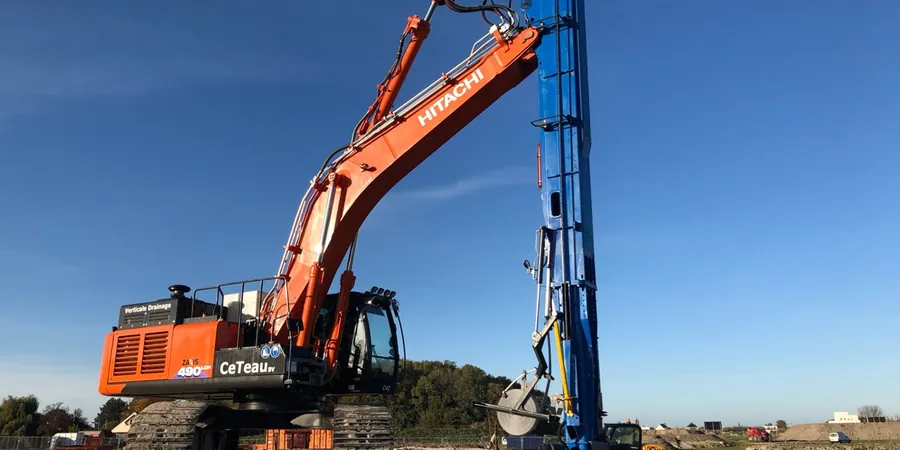
Our field setup for PVD installation in Calgary uses a static pushing rig equipped with a steel mandrel and a replaceable anchor plate. The prefabricated drains are typically 100 mm wide and 4–6 mm thick, wrapped in a geotextile filter that meets ASTM D6913-17 particle retention criteria. We install them on a triangular grid with spacings between 1.2 m and 2.5 m, depending on the required degree of consolidation. The mandrel penetrates through the fill and into the underlying compressible layer, and we monitor the withdrawal speed to prevent smear zone formation. Once the drain is placed, we connect it to a horizontal drainage blanket.
Mandrel cross-section: 45 × 120 mm
Maximum depth: 35 m in Calgary's till
Filter permittivity: ≥ 0.1 s⁻¹
This setup works well even in the stiff clay found near the Nose Creek valley.
Technical reference image — Calgary
Local considerations
The difference between Calgary's southeast and northwest quadrants is striking. In the southeast, around McKenzie Lake, the soil profile features up to 12 m of soft clay and silt with a natural water content near the liquid limit. There, a PVD design with 1.8 m spacing works well. In the northwest, near Tuscany, the compressible layer is thinner but overlain by a stiff desiccated crust that can cause mandrel refusal or excessive smear. If we underestimate the smear zone, the radial drainage is choked and settlement takes twice as long. That is why we always run a permeability test on site to calibrate the horizontal coefficient of consolidation before finalizing the drain layout.
We run incremental loading consolidation tests (CSA + CSA + CSA + CSA + ASTM D2435 (also CFEM Ch 2) (also CFEM Ch 2) (also CFEM Ch 2) (also CFEM Ch 2) (also CFEM Ch 2)) on undisturbed tube samples from the compressible layers. The lab reports cv, cc, and pre-consolidation pressure, which directly feed into the PVD spacing calculations. Turnaround is 14 business days for a full test series.
02
Settlement Monitoring
We install settlement plates and piezometers at multiple depths to track the actual consolidation rate during the surcharge period. Data is logged weekly and compared against the design curve. If the observed rate deviates by more than 15%, we adjust the drain spacing or surcharge height.
How do I determine the correct PVD spacing for my Calgary project?
The spacing depends on the required degree of consolidation (U) and the time available. We calculate it using Barron's radial consolidation equation, with cv and ch values from your site-specific consolidation test. For Calgary's typical lacustrine clay, a spacing of 1.5 m to 2.0 m is common for U = 90% in 12 months.
What is the cost range for a PVD design and installation plan in Calgary?
The design and testing package typically ranges between CA$1,180 and CA$3,110, depending on the number of boreholes and consolidation tests required. Installation costs are additional and vary with depth and quantity of drains.
Do I need a geotechnical investigation before PVD design?
Yes. You need at least two boreholes per hectare with undisturbed sampling down to the full depth of the compressible layer. We also need classification tests (Atterberg limits and natural water content) plus at least one consolidation test per soil unit. Without these, the design parameters are unreliable.
Can PVDs be installed in Calgary's stiff glacial till?
Yes, but the stiff desiccated crust common in areas like Tuscany or Edgemont may require pre-augering or a heavier static rig. We have installed drains down to 25 m through till with a mandrel pressure of up to 150 kN. The key is to avoid excessive smear by controlling the penetration rate.