We roll out with a portable drill rig and a set of Shelby tubes, because in Calgary the glacial till and lacustrine clays demand undisturbed sampling for any reliable evaluation. The shrink-swell potential here is no joke — we've seen basement slabs heave 40 mm in a dry summer followed by a wet fall. Before we even run the oedometer, we classify the soil visually using CFEM and then take it to the lab for free swell tests and Atterberg limits. That data feeds directly into foundation design decisions, often alongside a clasificacion de suelos to cross-check the USCS group and confirm the clay's activity ratio.
A plasticity index above 35 combined with free swell over 8% demands a foundation system designed for movement, not just bearing capacity.
Methodology and scope
Calgary's urban expansion since the 1970s pushed development onto the Bearspaw and Paskapoo formations, both rich in montmorillonite clays that change volume drastically with moisture. The city's semi-arid climate — about 412 mm of precipitation per year — means the natural moisture content sits near the plastic limit, so any additional wetting from lawn irrigation or leaking pipes can trigger differential heave. We've tested samples from McKenzie Towne to Aspen Woods showing plasticity indices above 35 and free swell values over 8%. To quantify this behavior we run consolidation tests with inundation cycles, and we always cross-reference the results with limites de Atterberg to map the clay's full plasticity envelope before writing recommendations.
Technical reference image — Calgary
Local considerations
NBCC 2020 requires that expansive soil hazards be addressed in geotechnical reports, and in Calgary this is non-negotiable. The city's clay deposits can generate swelling pressures exceeding 150 kPa, enough to crack a slab-on-grade or lift a light foundation wall. We've investigated houses in the northwest where post-tensioned slabs were specified after our evaluation showed a potential differential movement of 30 mm over a 10 m span. For sites like these we recommend moisture barriers and controlled fill placement, and we always flag the risk during the design phase rather than after the concrete is poured.
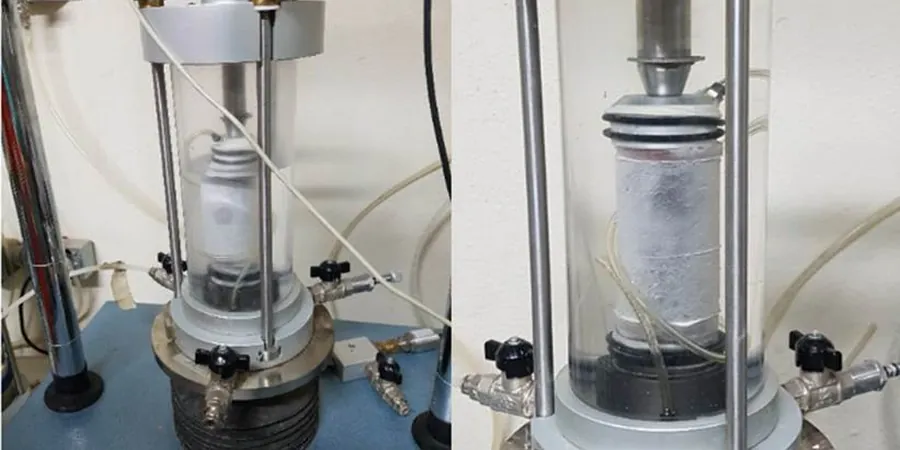
Free swell, swelling pressure, and consolidation tests run on undisturbed samples per ASTM D4546 (CFEM Ch 4) (CFEM Ch 4) (CFEM Ch 4) (CFEM Ch 4) (CFEM Ch 4). Includes Atterberg limits, natural moisture content, and activity ratio to classify the clay's expansion potential.
02
Field Moisture Monitoring & Site Investigation
Seasonal moisture profiling using neutron probes or dielectric sensors across the active zone (typically 2.5 – 4.5 m deep in Calgary). We combine this with test pit logging to map clay layers and identify desiccation cracks that could accelerate heave.
How does Calgary's climate affect expansive soil behavior?
Calgary's semi-arid climate with long dry spells followed by heavy rain events creates extreme moisture cycles. The natural clay dries out in summer, shrinks, and then swells when moisture returns, often causing differential movement in foundations. Our evaluations account for this by testing samples at both natural and saturated conditions.
What lab tests are essential for evaluating expansive soils in Calgary?
We always run free swell tests (ASTM D4546 (CFEM Ch 4) (CFEM Ch 4) (CFEM Ch 4) (CFEM Ch 4) (CFEM Ch 4)), Atterberg limits (CSA A23.2-2A), and consolidation with inundation. For high-plasticity clays we also measure swelling pressure under confined conditions, typically between 50 and 200 kPa in Calgary's Bearspaw formation.
What foundation design options work best for Calgary's expansive clays?
Post-tensioned slabs, pier-and-beam systems, and stiffened rafts are common solutions. The choice depends on the swelling pressure and active zone depth. For sites with PI above 35 and swelling pressure over 150 kPa we often recommend deep piles extending below the active zone.
How much does an expansive soil evaluation cost in Calgary?
A standard evaluation including sampling, lab tests, and a geotechnical report ranges between CA$730 and CA$2,430, depending on site access, number of borings, and the complexity of the clay profile. We provide a detailed quote after the initial site walk.