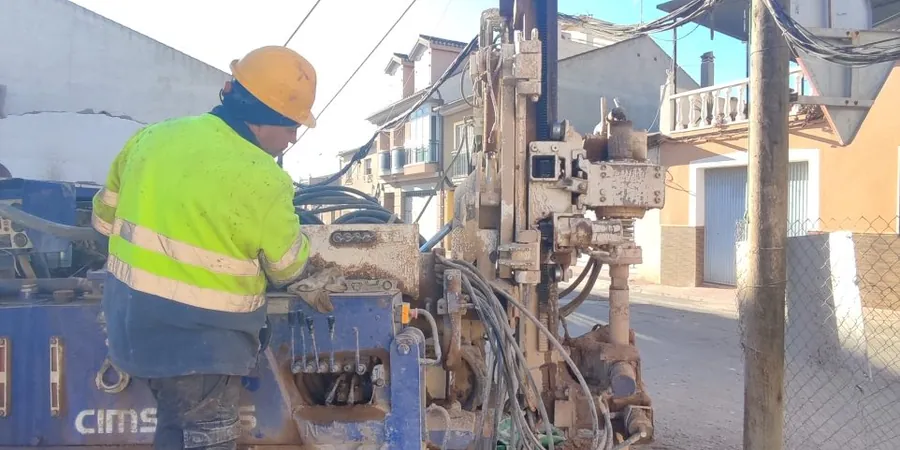
Calgary's rapid expansion since the 1970s pushed development onto variable glacial till plains and ancient river terraces. The Bow River and Elbow River carved deep channels, leaving complex sequences of clay till, sand lenses, and gravel outwash. For low-headroom retrofits or sites with shallow bedrock, micropiles offer a high-capacity foundation solution with minimal vibration. We integrate our design with local borehole data from the city's geotechnical database and complement it with field density testing to verify compaction of backfill around pile collars.
Glacial till in Calgary can vary from stiff to very dense within one borehole, demanding a design that accounts for abrupt changes in skin friction.
Methodology and scope
In Calgary, the main challenge is the cemented till layer that varies from stiff to very dense within a single borehole. Our team often sees compression strength values exceeding 400 kPa in the upper till, then dropping sharply in water-bearing sand lenses. We design micropiles to mobilize skin friction in the competent till while using a steel casing to prevent collapse in the overlying collapsible soils. A critical step is verifying the bond zone capacity through a preliminary test pile program. Before finalizing the design, we cross-check stratigraphy with MASW profiling to detect hidden sand channels that could alter load transfer.
Technical reference image — Calgary
Local considerations
Calgary sits at 1,045 m above sea level with a frost depth reaching 1.8 m. Seasonal freeze-thaw cycles can induce heave forces on shallow foundations, but micropiles designed below the frost line bypass this risk entirely. The real hazard lies in undocumented sand and gravel lenses within the till — they can drain grout during installation, reducing bond zone integrity. Our design includes a minimum casing length of 2 m below the seasonal frost line and a grout take contingency of 20% to account for these local anomalies.
Designed for building upgrades and seismic retrofits where headroom is limited. We use Type B micropiles (post-grouted) to achieve capacities up to 900 kN in competent till.
02
Slope Stabilization Micropiles
For cut slopes along Deerfoot Trail or the Bow River escarpment, we design raked micropile groups to resist lateral sliding forces and control differential movement.
Applicable standards
NBCC 2020 (National Building Code of Canada), Division B, Part 4, CSA A23.3-19 (Design of Concrete Structures), CSA A23.2-9A / CSA A23.2-9A / CSA A23.2-9A / CSA A23.2-9A / CSA A23.2-9A / ASTM D1586 (Standard Test Method for Standard Penetration Test)
Frequently asked questions
What is the typical cost range for micropile design in Calgary?
The design and engineering component typically ranges between CA$1.960 and CA$6.800, depending on site complexity, number of test piles, and reporting requirements. Installation costs are additional.
How does Calgary's glacial till affect micropile bond zone design?
The till matrix provides high skin friction (80–150 kPa), but interbedded sand lenses can reduce bond strength. We design the bond zone to fully engage the competent till and require a minimum casing through any granular layers to prevent grout loss.
What capacity can we expect from a micropile in Calgary's Bow River floodplain?
In the floodplain, soft alluvial clays and loose sands dominate the upper 6–10 m. A micropile socketed 4 m into the underlying dense till can achieve 400–600 kN in compression. Uplift capacity is typically 50–60% of compression.
Do micropiles require a test pile program before production?
Yes. NBCC 2020 and CSA A23.3 require a minimum of one static load test per site unless prior data exists. We recommend two test piles in Calgary to capture the till variability, with the first at 200% of design load.