We worked on a site near the Bow River where a 5-meter excavation started seeping within hours. The contractor had not anticipated the perched water table sitting above the dense clay till. That is where geotechnical drainage design becomes non-negotiable. In Calgary, the interaction between spring melt and low-permeability soils can turn a dry pit into a mud pond overnight. Our approach starts with a detailed site investigation to confirm flow paths. We then combine gravity drains, sump systems, or relief wells depending on the target depth. Before any drain is laid we run field permeability tests to validate the assumed hydraulic conductivity. For projects on the east side of the city we often recommend a permeability field test to confirm infiltration rates in the sandy silt layers. That data directly shapes the pipe spacing and filter design. It is practical engineering, not guesswork.
A gravel seam only 30 cm thick can drain an entire hillside if intercepted correctly. That is the difference between a stable slope and a failure.
Methodology and scope
Calgary expanded rapidly after the 1960s oil boom, pushing developments onto glacio-lacustrine plains and ancient river terraces. Those terraces contain complex layering of till, sand lenses, and gravel channels. Our geotechnical drainage design must account for these abrupt changes in permeability. A gravel seam only 30 cm thick can drain an entire hillside if intercepted correctly. We design french drains, blanket drains, and wick drains tailored to each stratigraphy. On a recent residential subdivision in the northwest we used a combination of trench drains and perforated pipe collectors. For large cut slopes we integrate horizontal drains drilled into the slope face. The system must also handle Calgary's freeze-thaw cycles, so we specify filter fabrics that resist clogging from ice lenses. We also incorporate deep soil mixing when the native till requires stabilization before drainage layers are placed. Every design gets peer-reviewed internally before it reaches the client.
Technical reference image — Calgary
Local considerations
Calgary sits on a thick sequence of glacial till with variable sand and gravel interbeds. The water table can fluctuate more than 3 meters between spring and fall. That creates a real risk of hydrostatic uplift on basement slabs and retaining walls. A poorly designed drainage system can saturate the backfill and double the lateral earth pressure. We have seen retaining walls bow 50 mm in a single season because the weep holes were undersized. Seasonal frost heave also damages shallow drains unless they are placed below the frost line. Our geotechnical drainage design includes a risk assessment for each soil unit encountered. We check for the presence of dispersive clays that can erode internally under seepage. We also model the effect of extreme rainfall events using the Calgary IDF curves. The goal is to keep the groundwater where it belongs: away from the structure.
Perimeter drains, sump pump systems, and sub-slab depressurization for residential and commercial basements. Designed to prevent hydrostatic pressure on the foundation walls.
02
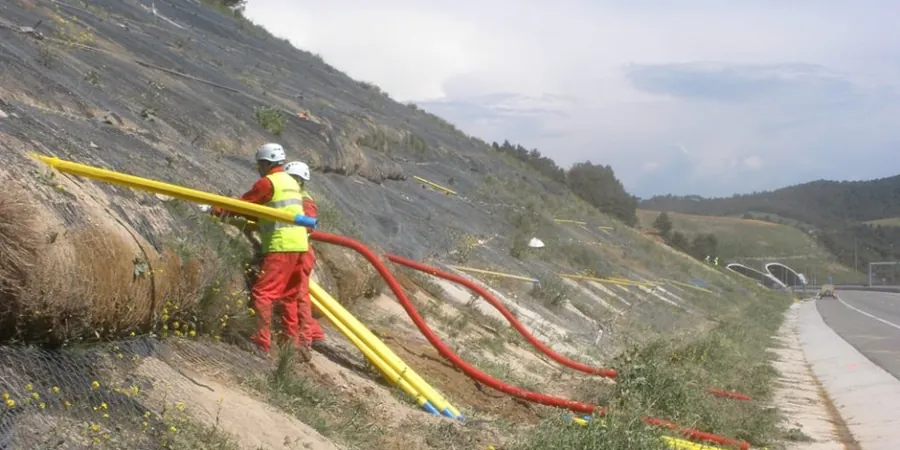
Cut Slope and Retaining Wall Drainage
03
Landfill and Pond Liner Drainage
Leachate collection layers, gas venting layers, and secondary drainage nets. We specify geotextiles and granular materials that meet Alberta Environment guidelines.
Applicable standards
NBCC 2020 (Section 4.1.6 — groundwater control), CSA Z768 (standard practice for design of groundwater monitoring wells), CSA A23.3-14 (design of concrete structures — drainage provisions), FHWA-NHI-05-071 (highway drainage guidelines applicable to urban cuts)
Frequently asked questions
What is the difference between a french drain and a curtain drain?
A french drain is a trench filled with gravel and a perforated pipe that collects and conveys groundwater. A curtain drain is an intercepting trench placed upgradient of a structure to block lateral flow. Both are common in Calgary, but the choice depends on whether the source is perched water or a regional water table.
How deep should a drainage system be in Calgary to avoid frost damage?
We recommend a minimum depth of 1.2 meters below grade. That places the pipe below the typical frost penetration depth for Calgary. If shallow installation is unavoidable, we insulate the backfill or use a heat trace system to prevent ice blockage.
Do I need a geotechnical drainage design for a residential basement in Calgary?
Yes, especially if your lot is on a slope or near a watercourse. Even flat lots in the southeast have perched water tables after snowmelt. A proper design prevents water intrusion, mold, and long-term foundation movement. The cost is small compared to fixing a wet basement.
What is the typical cost range for a geotechnical drainage design in Calgary?
For a standard residential lot with one drainage system, expect a range of CA$1,300 to CA$2,920. This includes site visit, soil review, design calculations, and a stamped drawing. Larger commercial projects are quoted per phase based on catchment area and complexity.