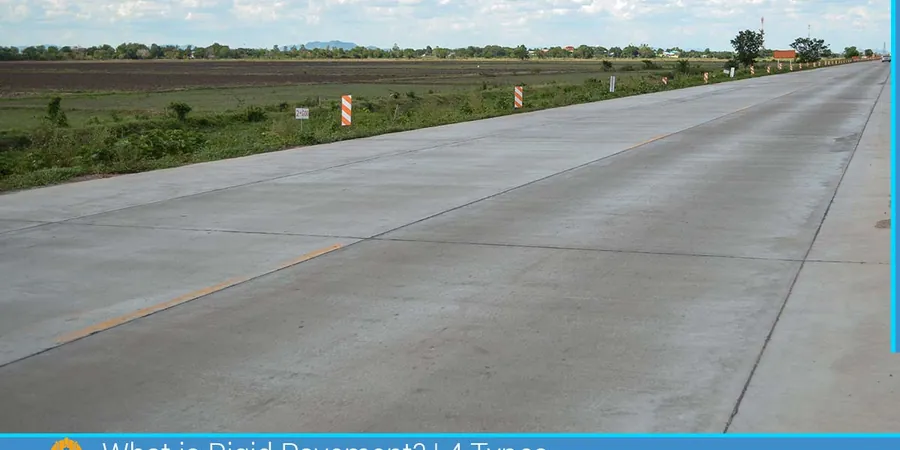
Driving from a warehouse in the southeast industrial district near Deerfoot Trail to a residential street in Brentwood, you cross very different subgrades. The glacial till and clay-rich soils around downtown Calgary behave nothing like the gravelly alluvial deposits found along the Bow River valley. A rigid pavement design that works for a parking lot in the northeast may crack within two seasons on the softer, moisture-sensitive soils of the southwest. That is why every project we take on starts with a thorough site investigation — we map the soil variability block by block. Before placing any concrete slab, we complement our analysis with a detailed subgrade evaluation and often recommend a CBR test to confirm the support layer meets the required modulus of subgrade reaction.
Frost heave is the number one cause of rigid pavement failure in Calgary — our designs counter it with site-specific k-values and proper drainage.
Methodology and scope
Calgary’s semi-arid climate and extreme temperature swings — from -35°C in January to +35°C in July — create unique demands for rigid pavement. The frost penetration depth can reach 1.8 meters, which means the slab and base layers must resist both upward frost heave forces and the subsequent thaw weakening. Our engineers use the modified Westergaard analysis, calibrated with local soil data from over 200 sites in Calgary, to determine slab thickness and joint spacing. We integrate the subgrade characterization directly into the design, adjusting the k-value for seasonal moisture changes. The result is a pavement that handles the freeze-thaw cycle without mid-panel cracking or faulted joints, even on high-traffic arterial roads like Macleod Trail.
Technical reference image — Calgary
Local considerations
A common mistake we see is contractors assuming a single slab thickness works across an entire site. In Calgary, a developer poured a uniform 200 mm slab over a parking lot in the southeast, only to find differential heave after the first winter — the clay pockets under the middle of the lot lifted 40 mm while the sandy edges stayed flat. The repair cost more than double the original pavement work. We avoid that by dividing the site into subgrade zones, each with its own design thickness and joint layout, and by verifying the actual subgrade modulus through field testing before any concrete is placed.
4.5–6.0 m (dependent on slab thickness and aggregate interlock)
Frost protection layer (granular base)
≥ 1.5 m for frost-susceptible soils
Design life
20–40 years (standard for Calgary municipal roads)
Associated technical services
01
Subgrade Investigation & k-Value Determination
We perform plate load tests, CBR tests, and soil classification to define the modulus of subgrade reaction for each pavement zone.
02
Pavement Thickness Design & Joint Layout
Using ACI 330R and AASHTO methods, we calculate slab thickness, joint spacing, and dowel bar requirements for heavy truck traffic and freeze-thaw.
03
Frost Protection & Drainage Design
We design the granular base and subdrain system to remove water from beneath the slab and prevent frost heave in susceptible soils.
04
Construction Quality Control & Troubleshooting
Our team monitors concrete placement, checks joint sawing timing, and verifies cure strength to avoid early-age cracking.
Applicable standards
ASTM D1195/D1196 (plate load test for k-value), American Concrete Institute ACI 330R (parking lots) and ACI 325 (highways), NBCC 2020 (frost depth and geotechnical requirements), Calgary Road Construction Standards (City of Calgary specifications)
Frequently asked questions
What is the typical cost range for a rigid pavement design study in Calgary?
For a standard mid-sized project (e.g., a warehouse parking lot or a small subdivision road), expect between CA$2,870 and CA$9,000. The final price depends on the number of test pits, plate load tests, and the complexity of subgrade variability.
How does Calgary's freeze-thaw cycle affect joint spacing in rigid pavement?
Joint spacing must be shorter than the ACI maximum — typically 4.5 to 5.0 m — to prevent mid-panel cracking from thermal contraction and frost heave differentials. We also require load transfer dowels at all transverse joints on high-traffic routes.
Do you follow the City of Calgary's road construction standards for pavement design?
Yes, our designs comply with the City of Calgary Road Construction Standards, Section 6 (Pavement Design), and we coordinate with municipal engineers on all projects that will be turned over to the city.
What soil conditions in Calgary are most problematic for rigid pavement?
The biggest challenges come from highly plastic clay till (CH soils) in areas like the northwest and southwest quadrants, and from organic soils along the Bow River floodplain. Both require deeper frost protection and thicker slabs to avoid heave and settlement.